P·01 Find
Find where time and money leave the building
A look at how your operation actually runs, especially the handoffs between people and systems. The output is a ranked list of what it costs you.
AI Development
Revenue recovered, hours returned, decisions made on facts. AI Development is the discipline that produces those outcomes, not demos and not chatbots pasted on the side.
Performance Method
Entoura is an AI Development Studio, the firm you hire when you want your business to operate better. Software, automation, data, and AI are the tools we use to build that outcome.
A look at how your operation actually runs, especially the handoffs between people and systems. The output is a ranked list of what it costs you.
Each opportunity is sized, and the single one worth changing first is named. This is the Assessment, and it is free.
Agents, people, and the tools you already use, coordinated into one system around your operation. It runs inside the software your team already works in.
Models change, systems change, your business changes. Staying on keeps the orchestration doing its job as all three move.
What AI development is
AI engineered to turn what a business generates every day into structured outputs a system can act on. Gaps declared, nothing invented. Production AI, not a demo.
A model is one component. The engineering is everything around it: the data architecture that feeds it, the prompts and schemas that constrain it, the retrieval that grounds it in real information, the evaluation that measures it, and the fallbacks that catch it when it is wrong.
Most AI work stops at the demo. Production means the system handles messy data, edge cases, latency budgets, cost at scale, and the inevitable moment when the model confidently returns something wrong.
The model is one part.
The engineering is everything else.
All work has been anonymized.
Across development, healthcare, and retail:
The engineering
Frontier models: Claude, GPT-class, open-source where privacy or cost demands it, accessed through APIs and chosen per task. Capability at the problem, cost at expected volume, and data residency for the jurisdiction. The choice follows a decision framework, not a brand preference.
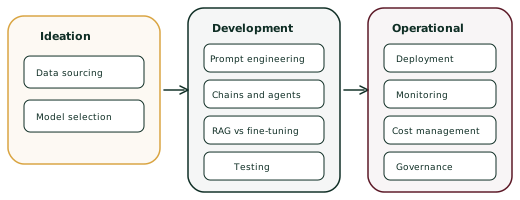
Models constrained by JSON schemas, including function calling, typed parameters, enum constraints, so every response has a shape a system can consume. Missing data is declared as unknown; the system never invents clinical or financial detail.
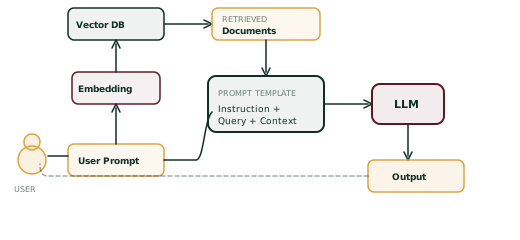
Text converted to vectors and queried by meaning instead of keywords; cosine distance over an embedded corpus finds what matches the intent of a question, even when it shares no words with it.
Answers drawn from the business's own documents, records, and knowledge, retrieved, assembled into context, reranked for relevance, and cited back to the source, not model opinion. The retrieval architecture decides what the model sees, how much, and in what order; that is what makes an answer something the business can trust and verify.
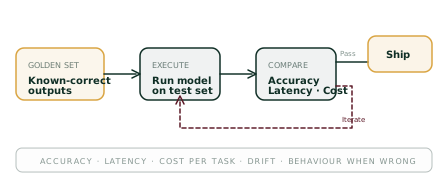
Every AI feature is evaluated against the client's own data before it reaches users: a golden set of known-correct outputs, accuracy and regression testing, latency budgets, and cost per task measured as a system, not optimized in isolation.
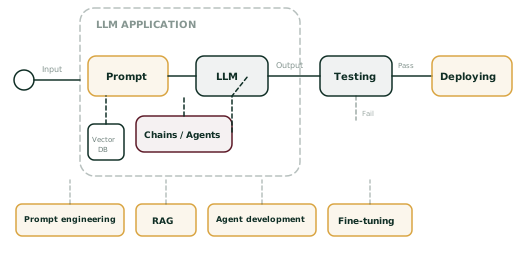
AI features live inside applications: queues, permissions, human-approval steps, monitoring, and audit trails. Fallback chains define what happens when a model is slow, wrong, or down. Data residency is decided in writing before anything is built: what reaches a model, what stays local, what gets logged.
Connected systems
A model that cannot read your data is a demonstration, not a system. So the work starts with what your clinic, office, or trade shop runs today: practice-management software, accounting and bookkeeping tools, scheduling platforms, CRMs, inboxes, and spreadsheets. The Blueprint is where we find out what each one can connect to, using an open standard where it exists and a connection we build where it does not.
The aim is AI that reads from and writes to the software your business already runs. Practice-management and booking platforms, accounting and bookkeeping tools, job-management software for trades, document stores, and inboxes. Where your data lives is where the AI works, and the Blueprint confirms how.
Where a documented, open path exists, including the Model Context Protocol, we use it, so the link between the AI and your systems is auditable and replaceable, not a black box. The Blueprint identifies which of your systems offer one.
The AI gets only the access a task requires: read for retrieval, write for defined actions, nothing more. Every operation is logged, so you can see what the system touched, when, and why.
When a system has no open integration path, the Blueprint assesses what is possible. Sometimes the answer is a purpose-built connection: a layer that reads the source and feeds the AI without exposing the system underneath. The Blueprint confirms what connects, and what it takes, before anyone commits to a build.
Your data stays where it is. The Blueprint scopes how the AI connects to it.
Data residency
Application data is hosted in Canadian regions. The Blueprint confirms which regions and services apply to your build.
What reaches a model, what stays local, and what gets logged is decided in writing before development begins.
You own the repository, the hosting accounts, and the data. Entoura can manage operations after launch; nothing is held hostage.
Canadian privacy law and any sector-specific requirements that apply to your business are scoped per build. Entoura supports the documentation and technical work. Questions start in the Blueprint.
Some operational services may run outside Canada; exactly what touches what is mapped per project. See Security for the full picture.
Beyond the desktop app
Team ChatGPT and Claude logins are the right tool for individual work. They stall the moment you need AI inside a repeatable workflow, reading your records, acting across systems, and running without someone at a keyboard.
APIs call the model from your own software, practice management, job tracking, intake forms, so work runs without someone opening a desktop app and copying text back and forth.
Enterprise API usage sets retention, logging, and residency in the contract. What reaches a model, what stays local, and what gets stored is documented before the build, not discovered in a privacy policy.
The architecture picks Claude, GPT-class, Gemini, or open-source per task, and can swap when a better fit arrives. You are not locked to whatever model a consumer app ships this quarter.
A handful of logins is cheap. A team running hundreds of tasks a day is not. API pricing is per token, fractions of a cent per prompt, and measured as a system in the Blueprint, not guessed from seat counts.
How we choose a model
Long-context reasoning, classification, extraction, or generation; the task defines the candidate list, not the logo.
A real-time field tool and an overnight batch pipeline have different budgets; both are measured, not assumed.
Cost per task at expected volume, projected forward; the economics are part of the architecture.
Canadian-hosted or privacy-critical workloads constrain the candidate list before capability is even scored.
When a better model arrives, your system is ready for it. The architecture is built to evolve.
This goes beyond calling a model. Open-source models are sourced, fine-tuned, and built on your own data, hosted on Canadian infrastructure you control.
What we build becomes yours to own: the models, the data, the system.
Have the data and a use case? Start with the Assessment to see whether a custom-trained model is right for you.
What we measure before launch
Measured against real inputs with verified outputs before any user sees a result.
The slowest experience that ships is defined in the Blueprint, then held to.
Unit economics at expected volume, reported plainly in the quote.
Fallbacks, human approval, and what the user sees when the model fails, documented, not discovered.
Selected work
All work has been anonymized.
Unstructured medical transcripts processed into structured, usable data. Extraction and interpretation of vital information, reducing administrative load on healthcare professionals.
View project Client work, anonymizedEnd-to-end site intelligence for land development: a spatial compliance engine that checks every bylaw rule against a project in seconds, AI-drafted planning rationale and variance justification, and daily monitoring of title, permits, and regulatory changes with alerts ranked by financial impact.
On a single marina project, the developer estimated $250,000 in avoided costs.
View projectAI is complicated. The studio takes care of that.
The Blueprint defines what reaches a model, what stays local, and what gets logged. In writing. Before development begins.
Start with the Blueprint™ $2,500 CAD · Credited in full toward your buildMore in AI Development
The control layer that coordinates agents, people, and tools across multi-step work.
→ Workflow AutomationAI that takes real action inside your business, with a person in command of every step.
→ Data DevelopmentWhy your proprietary data is the edge a shared model cannot copy.
→ Local AIOn-premise AI infrastructure for data that cannot leave the building.
→Wondering why a subscription is not enough? Why Custom-Built →
The operating system these build toward
AI development is the intelligence inside a connected operating system for your business.
Read the full guideGet in touch
We specialize in things that are unique to individual businesses. If that's you, contact us. A conversation is enough to make an educated decision.
Frequently asked
Often you can start without it. Some AI features work with public data, general-purpose models, or data the system collects over time. The Blueprint defines what data the system needs, where it comes from, and whether you need to collect or prepare it before development begins.
Whichever model fits the job. Claude for complex reasoning, GPT-class for structured extraction, open-source where cost or residency demands it. The Blueprint specifies the model, the rationale, and the swap path if a better option arrives.
Decided in writing during the Blueprint. Production application data is hosted in Canadian regions by default. What gets sent to a model API, what stays local, and what gets logged is documented and agreed before development starts. What touches infrastructure outside Canada is mapped per project.
Defined behaviour: fallbacks, confidence thresholds, human review queues, and graceful degradation. The system is built to handle model errors as a normal operational condition.
Scoped in the Blueprint. The Blueprint produces a fixed quote for the full build. Ongoing model costs are broken out plainly in the quote.
Yes, where the task warrants it. Open-source models can be deployed on infrastructure the client controls. The Blueprint evaluates both paths.
The architecture isolates the model so it can be swapped. New models get evaluated against the golden set. Improvements are adopted based on measured performance, not announcements.
For individual drafting, summarizing, and learning, yes, and you should. A subscription is a general-purpose tool a person opens and prompts. It has no standing connection to your systems, no memory of how your business runs, and it only acts when someone drives it. That is a productivity tool for a person, not an AI system for a business. When you need AI embedded in a workflow, governed, and reliable enough to depend on, you have outgrown the subscription.
When the work needs to run inside your software, not at a keyboard. APIs let you embed models in the tools you already use, choose the model per task (Claude, GPT-class, Gemini, or open-source), set data-retention terms in writing, and pay per token at volume instead of stacking $20–100/month seats across a team. That is the path from "everyone has a login" to a system the business runs on. The Blueprint defines whether you are there yet.
Get in touch
Confirm your call
You’re booked.
Confirmation sent. Carter will see you then.
By chatting you agree to our privacy terms. Stored in Canada; replies are generated by a US model provider.
I couldn’t reach the calendar just now. Here’s a direct booking link. Book a call
Still here. Ready whenever you are.
Try: "What is the Blueprint?", "How does AI Development work?", "What does a build cost?"